
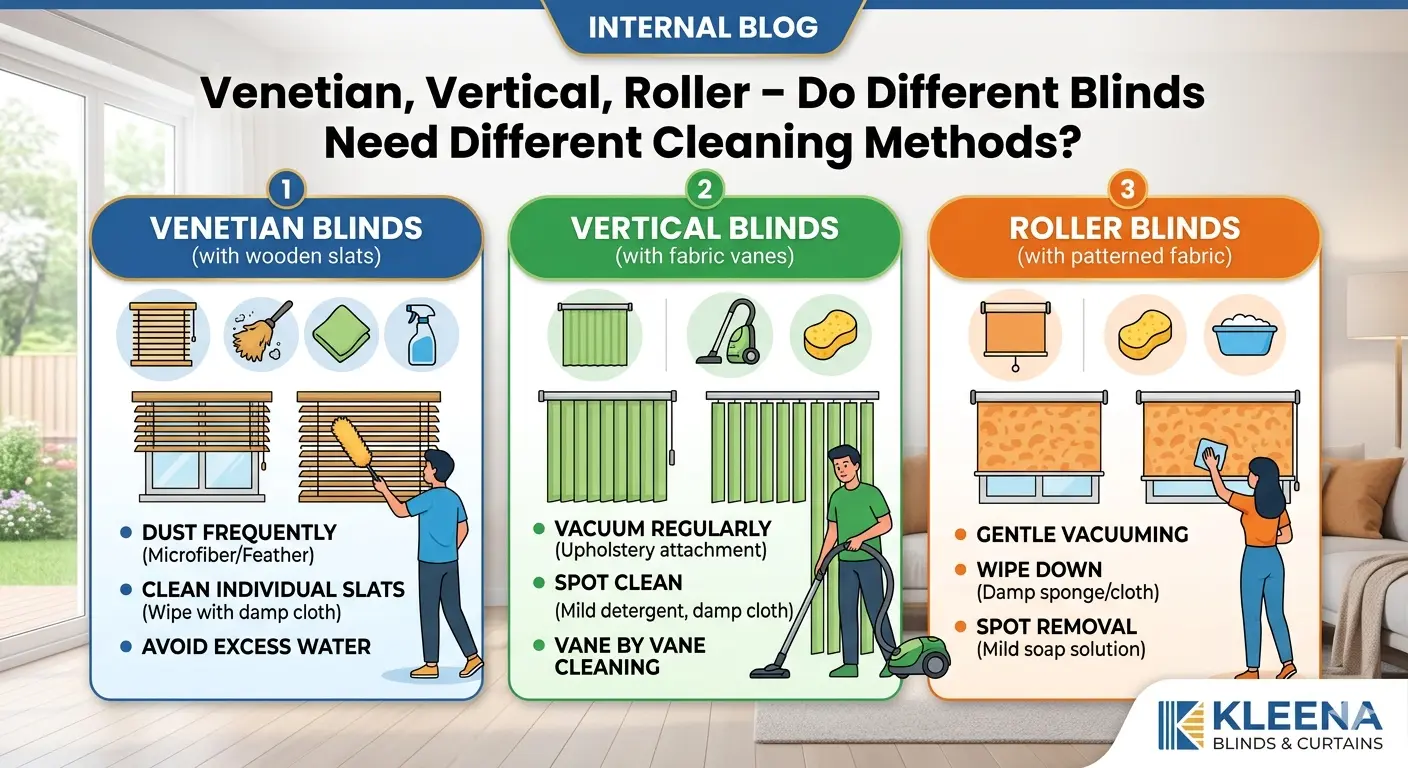
Blinds look simple.
They hang there. Quiet. Obedient. Filtering light like they’ve got their life together.
But here’s the thing nobody tells you: not all blinds collect dirt the same way. And they absolutely don’t respond to cleaning the same way either. Treat them the same, and you’ll shorten their lifespan faster than a Brisbane summer melts dashboard plastic.
Let’s talk about it properly.
Because if you’re in Brisbane, your blinds aren’t just catching dust. They’re catching humidity, airborne pollen, fine traffic particles, and that sticky film that builds up when warm air refuses to circulate.
Different blinds. Different mess. Different approach.
Venetian Blinds: The Dust Magnets With Attitude
Venetians are dramatic.
Aluminium, timber, PVC — doesn’t matter. Their horizontal slats are practically engineered to trap dust in neat little layers. It’s like each slat says, “Yes, I’ll hold onto that.”
Now here’s where most people go wrong: they wipe across the top slats and call it a day. Meanwhile, the undersides are building a grey ecosystem of grime and humidity residue.
In Brisbane’s climate, that residue can harden. Especially near busy roads. Especially in homes that keep windows cracked open for airflow.
Metal Venetians can handle moisture — within reason. Timber ones? Different story. Excess water can cause subtle warping that doesn’t show immediately. It creeps in. Weeks later, you’re wondering why they don’t close evenly.
That’s why proper blind cleaning Brisbane services treat Venetian blinds based on material, not just shape. Timber needs controlled moisture and careful drying. Aluminium can handle deeper cleaning but still requires attention to cords and tilt mechanisms.
Ignore that difference and you’ll feel it in the movement. Literally.
Vertical Blinds: The Static Collectors
Vertical blinds don’t trap dust the same way.
They attract it.
Fabric verticals, especially, tend to hold onto airborne particles like static-charged magnets. Add Brisbane humidity into the equation and you’ve got a subtle stickiness happening along the surface.
Most people vacuum them. That’s fine for maintenance. It’s not enough for buildup.
And here’s something interesting — vertical blinds near sliding doors on the Gold Coast often carry fine salt particles. You won’t see them. But they’re there. And over time, they dull the fabric and stiffen the texture.
PVC verticals are easier in theory. But harsh chemical sprays can cause discolouration. I’ve seen perfectly good blinds fade unevenly because someone thought supermarket cleaner was a safe bet.
The method matters. The solution’s strength matters. The drying method matters.
You can’t treat fabric and PVC the same. They might look similar from a distance. Up close? Different personalities entirely.
Roller Blinds: The Quiet Accumulators
Roller blinds are deceptive.
They look smooth. Minimal. Clean by design.
But that large flat surface? It’s basically an airborne landing strip.
In Brisbane homes, especially those facing direct sun, roller blinds collect a fine layer of dust that bonds with humidity. It forms a faint haze. Not obvious at first. Then one day you roll the blind halfway down and see streaking in the light.
Blockout roller blinds are even trickier. The backing material can degrade if scrubbed aggressively. And once that backing starts breaking down, there’s no fixing it. It’s replacement time.
That’s where homeowners face a decision: deep clean or move toward new blind installations?
And that decision depends on age, material condition, and whether the internal mechanism still moves smoothly. Because cleaning fabric is one thing. Fixing a fatigued roller system? Different cost conversation.
Why Brisbane Climate Changes Everything
If you lived somewhere dry and cool year-round, this would be simpler.
Brisbane doesn’t offer that luxury.
Humidity clings. Summer storms push fine debris through window gaps. Pollen levels spike during certain months. And coastal properties experience salt exposure even when they’re not directly beachfront.
Blinds in Brisbane age differently than blinds in colder cities.
They accumulate faster.
They stain deeper.
They warp easier if mishandled.
So no — a single cleaning method doesn’t make sense. Not here.
When Cleaning Isn’t Enough
Let’s be honest for a second.
Sometimes blinds are past it.
If the slats are bent. If cords are fraying. If the roller mechanism hesitates like it’s reconsidering its life choices. If fabric has permanent sun-bleached lines.
Cleaning won’t solve structural fatigue.
That’s when people start looking at new blinds Brisbane options instead of restoration. And that’s not a sales push — it’s practicality. There’s a point where maintenance costs more in time and effort than replacement.
At Kleena BC, we see both sides. Some blinds just need proper treatment. Others need retirement.
The trick is knowing the difference.
DIY vs Professional Cleaning: Where It Usually Goes Wrong
DIY isn’t evil. Let’s clear that up.
Light dusting? Fine. Routine vacuuming? Good habit.
But deep cleaning blinds without understanding material limitations can quietly damage them.
- Too much moisture on timber.
- Abrasive scrubbing on coated aluminium.
- Harsh chemicals on PVC.
- Over-saturation of roller fabrics.
The damage doesn’t scream immediately. It whispers. Slight stiffness. Slight fading. Slight misalignment.
Then six months later you’re wondering why they feel tired.
Professional blind cleaning Brisbane services factor in:
- Material composition
- Age and structural condition
- Environmental exposure
- Appropriate drying techniques
It’s less about elbow grease. More about restraint.
The Overlooked Factor: Mechanisms and Hardware
Here’s something most blog posts won’t mention.
Cleaning the visible surface is only half the story.
Venetian tilt rods. Vertical tracks. Roller springs.
Dust and humidity settle inside those mechanisms too. Over time, friction increases. Movement becomes uneven. That uneven strain can shorten the lifespan of the entire system.
A proper clean addresses more than what you see.
And if mechanisms are already worn? That’s when a conversation about new blinds becomes logical instead of reactive.
So… Do Different Blinds Need Different Cleaning Methods?
Yes.
But it’s more nuanced than that.
Different blinds need different cleaning intensity. Different moisture levels. Different chemical considerations. Different drying time. Different judgment calls.
And in Brisbane’s climate, those differences are amplified.
Treat them all the same and you’ll either under-clean them or slowly degrade them.
Neither is ideal.
A Practical Way to Think About It
Here’s a simple rule I tell homeowners:
If it bends easily, absorbs moisture, or has moving parts — it requires controlled cleaning.
If it’s rigid and coated, it still requires material awareness.
There’s no “spray and wipe” shortcut that works for every blind style.
That’s why at Kleena BC, we assess before we act. Venetian, vertical, roller — we treat them like separate categories, not interchangeable décor.
Because they aren’t.
And in Brisbane, where dust and humidity have a quiet partnership, the right cleaning method isn’t a luxury. It’s preventative maintenance.
Ignore that, and the blinds will remind you eventually.
Usually at the worst possible time.