
If you have a dog or a cat, you already know the feeling. You’ve just vacuumed the house, mopped the floors and wiped down the benchtops and then you look at your curtains. There’s a visible tide mark of fur along the bottom hem. The fabric smells faintly of wet dog even though the dog is dry. And no amount of lint rolling seems to make a lasting dent in it.
Pet hair and odour in curtains is one of the most common issues we deal with at Kleena Blinds & Curtains and one of the most satisfying to fix. Here’s exactly why it happens, why it’s harder to deal with than it looks, and what actually works.
Why Pet Hair Loves Curtains
Curtains are essentially a giant static-charged surface hanging at exactly the height where most dogs and cats move through a room. Animals brush against them constantly walking past, investigating an interesting smell outside, or simply using the fabric as a scratching or rubbing post. The fibres in most curtain fabrics are electrostatically attractive to pet hair, which is why lint rollers only ever seem to get the surface layer and why the fur is back within a day or two of you removing it.
The physics of it work against you. As you remove surface hair, the static charge of the fabric actually draws the remaining deeper hair upward to fill the gap. It’s not that new hair is appearing it’s that the hair that was always embedded in the weave is now at the surface, ready to be noticed again.
The odour problem is separate but equally persistent. Pet dander the microscopic flakes of skin that all animals shed constantly accumulates in fabric over time. The natural oils from an animal’s coat transfer to the curtain every time they make contact. The general ambient smell of an animal in the home is absorbed by fabric surfaces, curtains being among the largest. Once these odours are in the fibres at a molecular level, they don’t air out. They stay until the fabric is properly treated.
What Doesn’t Work — And Why
Most pet owners work through a predictable progression before calling a professional. Each of the common DIY approaches has a specific limitation that makes it inadequate for the problem.
Lint Rolling
Lint rollers are the first port of call for most people and they do remove surface hair but only the outermost layer sitting on top of the fabric. The hair that’s been worked into the weave through daily contact is completely unaffected. Within 24 to 48 hours, that deeper hair migrates back to the surface and the curtain looks exactly as it did before you rolled it.
Vacuuming With an Upholstery Attachment
Vacuuming is more effective than lint rolling and a genuinely useful maintenance step between professional cleans. But most domestic vacuums even good ones don’t generate enough suction to pull embedded hair from deep within a thick curtain fabric. They also risk distorting delicate fabrics, stretching heading tape or snagging embroidered or textured curtains if the attachment isn’t used carefully.
There’s also the filter issue. Household vacuums that aren’t fitted with a high-quality HEPA filter can actually spread fine pet dander through the exhaust rather than trapping it making the air quality in the room temporarily worse while you’re vacuuming.
Machine Washing
The machine wash is tempting it feels thorough but it carries real risk for most curtain types. Blockout curtains with acrylic backings can crack, peel or bubble under the mechanical stress of a wash cycle. Pinch pleat and pencil pleat curtains can lose their heading structure. Lined curtains may shrink unevenly, with the lining and the face fabric contracting at different rates and leaving the curtain puckered and misshapen. The result of a machine wash gone wrong is often a curtain that needs to be replaced, not just re-cleaned.
And even when the machine wash doesn’t cause obvious damage, it rarely fully addresses the odour. The detergent masks the smell temporarily, but without proper treatment and professional drying, the odour returns sometimes worse once the curtain is back in a warm room.
In-Home Steam Cleaning
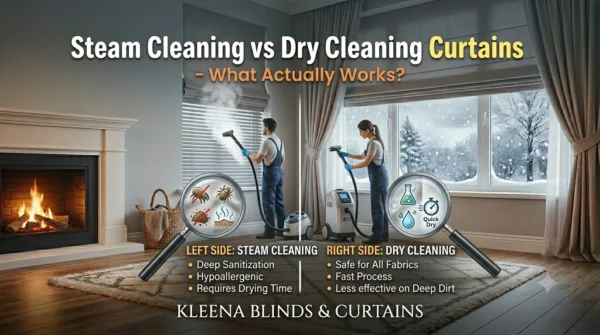
Steam cleaning addresses surface odour more effectively than the other DIY approaches, but it works on the surface of the fabric only. The steam penetrates perhaps a millimetre or two into the weave. The dander, oils and odour compounds embedded deeper in the fabric are unaffected. Worse, the moisture from steam cleaning can actually compress pet hair deeper into the weave, making it harder to remove in future.
What Actually Works
The only way to properly remove embedded pet hair and genuinely eliminate pet odour from curtains is a thorough professional off-site clean. At Kleena, our process is specifically designed to address exactly this problem:
• We take down every curtain carefully and transport them to our Ormeau facility no risk of further fur transfer in transit
• We use professional extraction cleaning that pulls pet hair out from deep within the fabric weave, not just the surface layer
• We treat pet odours with a neutralising agent that works at a molecular level breaking down the odour compounds rather than masking them with fragrance
• Every curtain is properly air dried in our facility before being returned and rehung completely dry, no musty dampness from insufficient drying
A Real Job — Yatala
A family from Yatala called us recently with exactly this problem. Two dogs and a cat had been sharing the house for several years, and the blockout and sheer curtains throughout the home had accumulated fur along the lower two thirds of every panel. The smell had become noticeable even to visitors who weren’t used to it.
We picked everything up between 9 and 10am. By 9am the following morning, the curtains had been cleaned, treated, properly dried and rehung. The family’s words were simple: fresh curtains for a happy family. That’s what a proper professional clean looks like and that’s the standard we hold every job to.
How to Manage the Problem Between Professional Cleans
Once your curtains have been professionally cleaned, a few simple habits will help extend the time before the next clean is needed. Vacuuming the lower section of your curtains with an upholstery attachment every two to four weeks removes surface hair before it has a chance to work itself deeper into the fabric. If your cat uses the curtains as a rubbing post, a deterrent spray on the lower hem can reduce contact. And keeping on top of regular grooming for long-haired breeds reduces the amount of hair your pets are shedding throughout the house.
None of these things replace a professional clean but they do mean you need one less frequently, and they make the result of each professional clean last longer.
How Often Should Pet Owners Clean Their Curtains?
If you have one or two short-haired pets who don’t make a lot of contact with the curtains, once a year is a reasonable target. If you have multiple animals, long-haired breeds, or animals that spend significant time near or against the curtains, twice a year is more realistic. For homes with family members who have allergies or asthma, the frequency of pet dander accumulation makes regular cleaning important not just cosmetically, but from a health standpoint.
Frequently Asked Questions
Not from the cleaning itself. Unlike masking sprays or home washes that temporarily cover the smell, professional treatment with a neutralising agent breaks down the odour compounds in the fabric permanently. The smell won’t return from what was there before the clean. If the pets continue making regular contact with the curtains, odour will gradually rebuild over time which is why regular cleaning is more effective than waiting until the problem becomes severe again.
Yes, gradually. The natural oils in pet coats transfer to the fabric on every contact, and over time these oils can cause fabric fibres to break down and the colour to dull unevenly. The physical friction of an animal rubbing against a curtain repeatedly also causes localised wear particularly along the lower hem and any section at the animal’s shoulder or face height. Regular cleaning removes the oils before they cause permanent damage and significantly extends the life of the curtain.
Yes pet hair and dander accumulate on roller blinds, venetian slats and vertical blind strips just as readily as on fabric curtains. If your home has both, we recommend having everything cleaned at the same time. It’s more efficient for you and produces a more consistent result throughout the house.
In most cases, yes particularly if the curtains are otherwise in good condition. Long-standing odour takes more thorough treatment, but our process is designed to handle exactly that. The only situation where replacement makes more sense than cleaning is when the fabric itself is structurally degraded or the blockout coating is already peeling and cracking. We’ll give you an honest assessment when we come to pick up.
Don’t Let the Problem Get Worse
Pet hair and odour in curtains is the kind of problem that becomes background noise you stop noticing it because it’s always there. But visitors notice. And every day it’s left, the problem gets a little harder to address. A professional clean gets you back to a clean baseline, and the maintenance habits to keep it there are genuinely simple.
Got pet hair on your curtains? Call us on 07 5549 0996 or visit www.kleenabc.com.au. We pick up, clean, deliver and rehang — often within 24 hours for Gold Coast locals.